

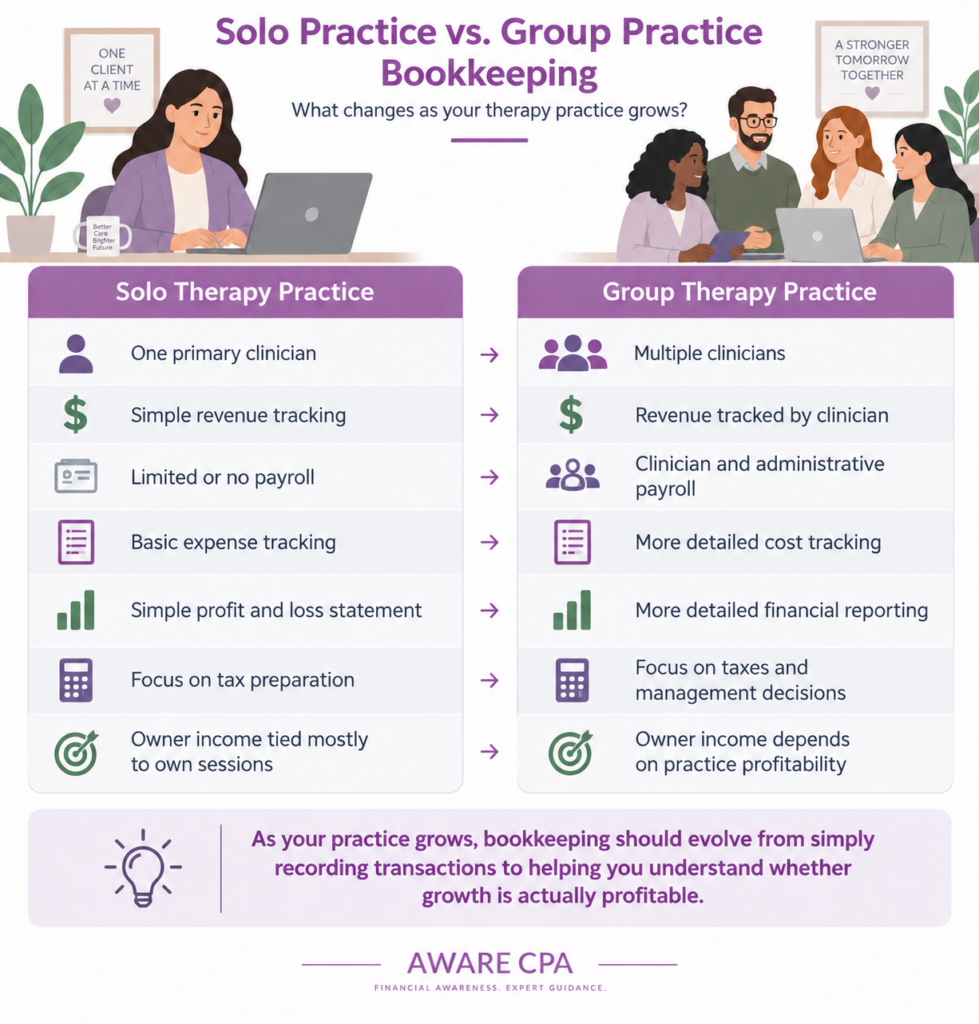
Growing from a solo therapy practice into a group practice changes much more than the number of clinicians on your team. Your bookkeeping becomes more detailed, payroll and worker classification become more important, your tax structure may need to be revisited, and financial reporting becomes increasingly important for understanding whether the practice is actually profitable.
For a solo therapist, bookkeeping may primarily track the revenue and expenses associated with one clinician. Once you begin hiring therapists, you are operating a business that earns revenue through the work of multiple people and incurs additional costs to support them.
So, how do bookkeeping and taxes change when a therapist moves from solo practice to group practice?
The biggest changes typically involve:
- More detailed bookkeeping and financial reporting
- Payroll and clinician compensation
- Employee versus independent contractor classification
- Potential changes to your entity or tax structure
- S Corporation reasonable compensation
- Estimated tax planning
- Measuring clinician and practice profitability
Understanding these changes before you hire can make the transition considerably easier.
How Does Bookkeeping Change When You Move From Solo to Group Practice?
A solo therapist can often get useful information from a relatively simple profit and loss statement. For a group practice, total revenue and total expenses are no longer enough.
You may now want to understand:
- How much revenue each therapist generates
- How much each therapist costs the practice
- Payroll and payroll tax expense
- Contractor payments, if applicable
- Administrative payroll
- Billing and credit card processing costs
- Incremental software costs
- Rent and other overhead
- The profitability of the practice before and after owner compensation
Your chart of accounts and financial reporting may need to become more detailed as the practice grows. Instead of simply asking whether the books are accurate enough to prepare a tax return, a group practice owner should be able to use the accounting records to answer questions such as:
How much revenue are our clinicians generating?
How much does it cost to employ them?
Is additional revenue actually producing additional profit?
For a growing therapy practice, bookkeeping should increasingly function as a management tool, not simply a tax-preparation requirement.
If you are still building the accounting foundation for your practice, our guide to bookkeeping for therapists explains what good bookkeeping should include and why it matters.
Payroll Becomes a Much Bigger Part of the Business
For many group practices, clinician compensation becomes the largest expense.
If therapists are employees, the practice may be responsible for more than the wages shown on their paychecks.
Additional costs can include:
- Employer Social Security and Medicare taxes
- Federal and state unemployment taxes
- Workers’ compensation
- Benefits
- Payroll processing fees
- Paid time off, depending on the compensation structure
This means a therapist earning $70,000 in wages may cost the practice considerably more than $70,000. In addition to wages, the employer generally incurs its share of Social Security and Medicare taxes, unemployment taxes, workers’ compensation, payroll processing costs, and any benefits provided.
Understanding the fully loaded cost of a clinician becomes important when determining what the practice can afford to pay, whether a new hire will be profitable, and how much revenue that clinician needs to generate.
Should Therapists Be Employees or Independent Contractors?
One of the first questions a new group practice owner may face is whether clinicians should be treated as employees or independent contractors.
The answer cannot simply be chosen based on which arrangement is cheaper or easier to administer. Worker classification depends on the actual working relationship and applicable federal and state rules. Calling a clinician an independent contractor in an agreement does not, by itself, establish that classification for tax purposes. For therapy practices, factors such as control over schedules, supervision, how services are provided, and the overall relationship between the practice and clinician can all matter.
The classification also changes the bookkeeping.
Employee compensation is generally recorded through payroll, while contractor payments are accounted for differently and may create Form 1099 reporting requirements.
Before adding clinicians, group-practice owners should make sure their compensation model and worker classification have been reviewed by the appropriate legal and tax professionals.
Group Practice Revenue Is Not the Same as Owner Income
This is one of the biggest financial mindset shifts when moving from solo practice to group practice.
As a solo therapist, most practice revenue is generated directly from your own clinical work. After paying practice expenses, the remaining profit generally belongs to you.
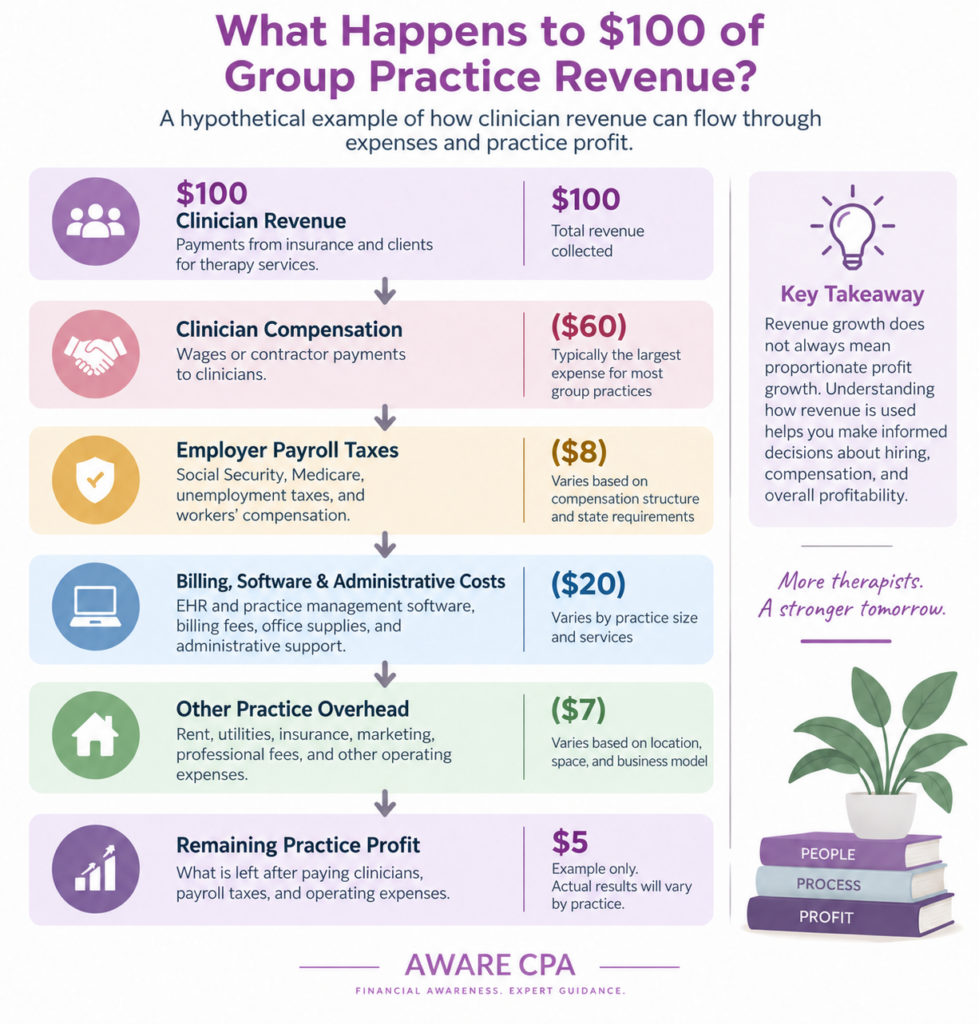
A group practice operates differently. A clinician may generate $100,000 of annual collections, but the practice must use part of that revenue to pay clinician compensation, employer payroll taxes, billing costs, software, administrative support, rent, and other overhead.
What remains after those costs contributes to the profitability of the business.
This distinction becomes increasingly important as the practice grows. A group practice can generate significantly more revenue than a solo practice without generating proportionately more income for its owner.
The goal should therefore not simply be to increase revenue. The owner should understand whether each stage of growth is creating additional profit.
Your Tax Structure May Need to Be Revisited
Adding therapists does not automatically require you to change your tax structure.
However, growth is a good time to reevaluate whether your current structure still makes sense.
A therapist may have started as a sole proprietor or single-member LLC and later elected S Corporation taxation as profits increased. If you are evaluating whether an S Corporation may make sense for your practice, see our guide to S Corporations for therapists.
Other group practices may introduce an additional owner, which can create an entirely different tax situation.
If a single-member LLC adds another owner, the LLC will generally become a partnership for federal income tax purposes unless another tax election applies.
Importantly, hiring another therapist does not make your business a partnership. The tax classification generally changes when another person receives an ownership interest in the practice, not simply because you hire employees or contractors.
That means the practice may now have a separate business tax return, different owner compensation rules, and additional tax-planning considerations.
This is an area where planning before ownership changes occur is particularly important.
S Corporation Reasonable Compensation Can Become More Complicated
If your practice is taxed as an S Corporation and you work in the business, reasonable compensation remains important.
But your role may begin changing as the practice grows.
A solo therapist may spend most of their time seeing clients.
A group-practice owner may gradually spend more time:
- Managing clinicians
- Recruiting
- Supervising staff
- Reviewing financial results
- Handling operations
- Developing referral relationships
- Managing the business
Reasonable compensation should reflect the services the owner actually performs for the S Corporation. As a therapist transitions from primarily providing clinical services to managing clinicians and operating a larger practice, both the nature and value of those services may change.
For that reason, reasonable compensation should not necessarily be treated as a number that is calculated once and never revisited.
For a deeper explanation of how salary should be evaluated, see our guide to reasonable compensation for therapists with an S Corporation.
Your Estimated Taxes May Change Too
Growing practice revenue does not necessarily mean taxable income will increase at the same rate. A group practice may generate substantially more revenue while also taking on significant new expenses, including clinician compensation, employer payroll taxes, administrative payroll, software, and other overhead.
At the same time, a successful group practice may ultimately produce significantly more taxable profit than a solo practice.
Estimated tax payments should therefore be based on projected taxable income, not simply on revenue growth.
This is another reason current bookkeeping matters. If your books are accurate and up to date, your CPA can use actual year-to-date results to project annual income and adjust estimated tax payments before year-end.
Financial Reporting Becomes More Important
When there is only one clinician, bookkeeping is often viewed primarily as a tax-compliance function.
In a group practice, bookkeeping becomes a management tool.
A practice owner may want to monitor:
- Revenue by clinician
- Clinician compensation as a percentage of revenue
- Total payroll cost
- Gross margin
- Administrative expenses
- Practice net income
- Owner compensation
- Cash reserves
- Budget versus actual results
These numbers can help answer questions such as:
- Can I afford to hire another therapist?
- Can I increase clinician compensation?
- Is the practice actually becoming more profitable as revenue grows?
- Do I need additional administrative support?
Those are business decisions, but they depend on good accounting information.
Is Your Group Therapy Practice Actually More Profitable?
Revenue growth and profit growth are not the same thing.
Suppose a solo therapist generates $200,000 of annual revenue with relatively modest overhead. After expanding into a group practice, total revenue eventually reaches $1 million.
The $1 million practice may now have substantial clinician payroll, employer payroll taxes, administrative staff, billing costs, software, rent, marketing, and other overhead.
The better question is therefore not:
How much revenue does my group practice generate?
It is:
How much profit does the practice generate after accounting for the people and resources required to produce that revenue?
A practice may appear highly profitable on paper if the owner is performing substantial clinical, supervisory, or administrative work without separately considering what that labor is worth. If the owner continues seeing clients, managing clinicians, supervising staff, and operating the business, simply looking at accounting net income may not tell the entire economic story.
Understanding this distinction can help owners evaluate whether adding clinicians is creating a more valuable business or simply creating more revenue and more work.
What Should a Solo Therapist Do Before Hiring Their First Clinician?
The best time to think about group-practice accounting is before the first clinician joins.
Before expanding, consider discussing the following with your CPA and other advisors:
- How clinicians will be compensated
- Employee versus contractor classification
- Payroll setup
- Whether your existing entity and tax election still make sense
- Whether your bookkeeping system needs to change
- How you will track clinician-level revenue and costs
- How much cash the practice should keep available
- How you will determine whether a new hire is profitable
Ideally, these decisions are made before the first payroll is processed or the first clinician begins seeing clients. Changing accounting systems, correcting worker classification, or restructuring compensation after a group practice has already grown can be considerably more complicated.
A group practice can create meaningful growth opportunities, but it also requires stronger financial systems.
The bookkeeping, tax planning, and financial reporting that worked when you were the only therapist may no longer provide enough information once your practice begins supporting an entire team.
The earlier those systems are updated, the easier it becomes to understand whether growth is actually improving the financial health of the practice.
Need Help With the Financial Side of Growing Your Therapy Practice?
Aware CPA works with therapists and mental health practice owners on bookkeeping and tax services, S Corporation issues, and financial analysis.
If you are transitioning from solo practice to a group practice, we can help you understand how the change affects your bookkeeping and tax situation and build financial reporting that grows with your practice.
You can also learn more about how working with Aware CPA works before scheduling an Initial Consultation.
Schedule an Initial Consultation.