
If you’ve ever nerded out about taxes with other business owners or your social media feed keeps serving up “can’t-miss” tax advice, you’ve probably heard this before:
“You should become an S Corp. It’ll save you a lot in taxes.”
It’s one of the most common tax recommendations shared in the wild. And while an S Corporation election can provide meaningful tax savings in the right circumstances, it isn’t the right choice for every therapist, psychologist, psychiatrist, counselor, or mental health practice.
The decision depends on far more than whether you own a private practice. We’ve had this conversation with solo therapists, psychologists, psychiatrists, and growing group practices. Some clients benefit substantially from an S Corporation election. Others would spend more on payroll, tax filings, and administration than they save. That’s why the answer is almost never as simple as “everyone should become an S Corp.”
Rather than asking whether an S Corporation is “good” or “bad,” the better question is whether it’s the right fit for your specific situation.
What Is an S Corporation?
One of the biggest misconceptions is that an S Corporation is a type of business entity.
It isn’t.
An S Corporation is a tax election that changes how your business is taxed. Many therapists, psychologists, psychiatrists, and other mental health professionals first establish an LLC before electing S Corporation taxation.
Making the election doesn’t change the services you provide or how you care for clients. Your clients won’t notice any difference. The change happens entirely behind the scenes in how your practice is taxed and how you pay yourself.
Why Do Therapists Consider an S Corporation?
The primary reason is the potential for tax savings.
In the right circumstances, having an S Corporation can reduce your overall taxes by eliminating self-employment taxes on a portion of your take-home earnings.
However, those potential tax savings must be weighed against the increased costs of running payroll for yourself, filing the S Corporation tax return, and the various legal fees for setting up the entity in the first place. There is also an intangible cost associated with the extra time spent figuring it all out. An S Corporation also makes accurate bookkeeping more important because payroll, shareholder distributions, and business expenses need to be recorded correctly throughout the year. Read my Bookkeeping for Therapists guide for more information.
When an S Corporation Often Makes Sense
Every practice is different, but an S Corporation election often deserves consideration when:
-
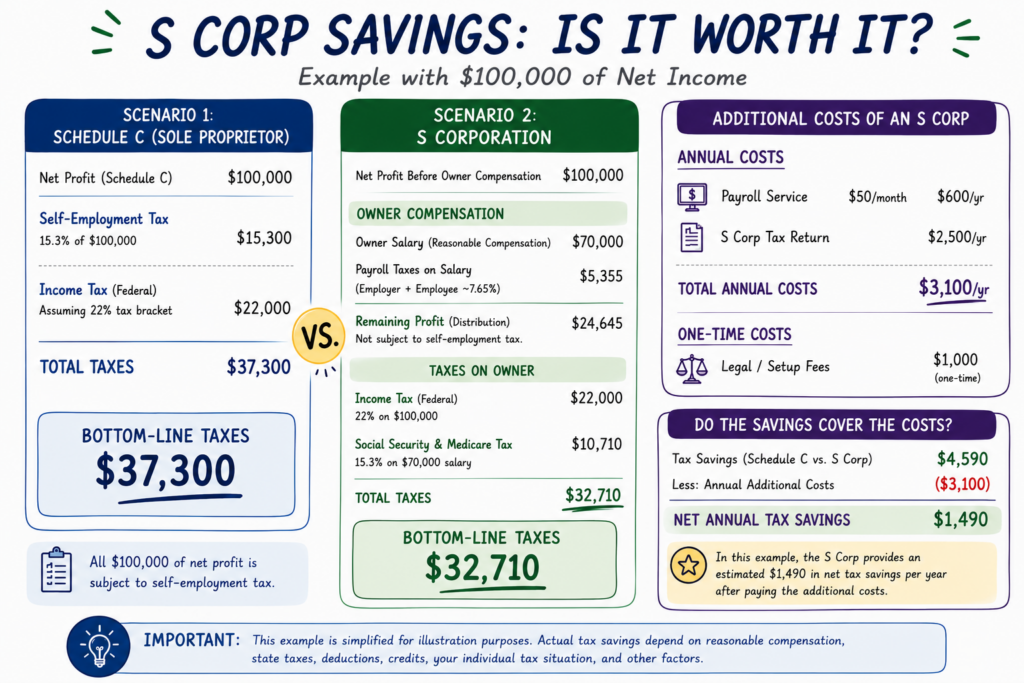
- Your practice consistently generates healthy net profits of $100,000 per year. In many cases, practices around this level begin to generate enough potential tax savings to offset the additional costs of an S Corporation. The illustration below demonstrates why.
-
- You’re earning more than what would generally be considered a reasonable salary for the work you perform. This topic is very important to get right. Learn more by reading my Reasonable Compensation for Therapists blog post.
-
- Your revenue is relatively stable or increasing from year to year.
-
- You’re ready to dedicate time for managing payroll and additional compliance requirements.
-
- The anticipated tax savings outweigh the added administrative costs.
These situations often arise as a practice matures and becomes more financially established.
Growth may also bring new bookkeeping, payroll, and tax considerations. If you are adding clinicians, read our guide to transitioning from solo to group therapy practice for the financial changes to consider as your practice expands.
Example: Could an S Corporation Save You Money?
This example is simplified to illustrate the mechanics of an S Corporation election. Your actual tax savings depend on your overall tax situation, reasonable compensation, state taxes, and other factors.
When It May Not Be the Right Choice
An S Corporation isn’t automatically beneficial simply because someone owns a private practice.
In some situations, remaining a sole proprietor or LLC may be the better option.
Examples include:
-
- A new practice that is still growing.
-
- Inconsistent or unpredictable profits.
-
- Limited income beyond what would reasonably be paid as salary.
-
- Situations where the additional administrative burden outweighs the financial benefit.
The goal isn’t to have the most sophisticated tax strategy. The goal is to have the right strategy for your practice.
How We Help Clients Decide
At Aware CPA, we specialize in helping therapists, psychologists, psychiatrists, counselors, and group practices evaluate whether an S Corporation election makes financial sense. We don’t recommend an S Corporation election simply because it’s popular or because another therapist had success with it.
Instead, we evaluate your practice as a whole.
We consider your profitability, expected compensation, tax situation, administrative capacity, and long-term goals before making a recommendation.
Sometimes an S Corporation election can save thousands of dollars each year. Other times, it creates additional costs without enough tax savings to justify the complexity.
The right answer is the one that supports your practice. Not someone else’s.
Final Thoughts
An S Corporation election can be a valuable planning tool, but it isn’t a universal solution.
Before making the change, it’s worth understanding both the potential benefits and the additional responsibilities that come with it.
If you’re wondering whether an S Corporation election makes sense for your practice, we’d be happy to help you evaluate your options and make a decision based on your specific circumstances.
Aware CPA specializes in bookkeeping, tax planning, tax preparation, and financial guidance for therapists, psychologists, psychiatrists, counselors, and mental health practices.