

Running a therapy practice means balancing client care with the financial responsibilities of owning a private practice. You are a mental health professional providing care to your clients, but you are also a business owner responsible for managing the financial health of your practice.
For many therapists, bookkeeping is something that happens in the background. Money comes in from clients or insurance companies, expenses get paid, and you pay yourself when cash flow allows. Everything seems to be working until tax season arrives and you discover that you owe the IRS thousands of dollars.
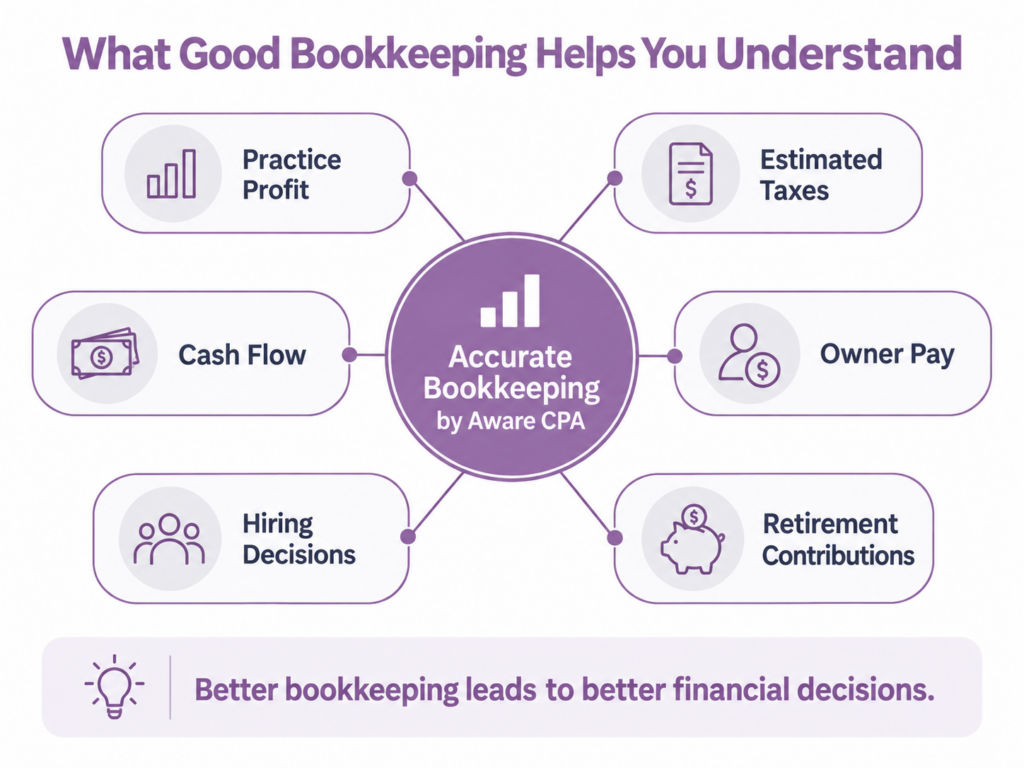
When your books are accurate and up to date, they can help you understand how profitable your practice really is, prepare for taxes, make better business decisions, and identify financial problems before they become expensive ones. Bonus points if your CPA can use those financial statements to prepare tax projections during the year so you are not left trying to interpret the numbers yourself.
What Is Bookkeeping?
At its simplest, therapist bookkeeping is the process of recording and organizing the financial activity of your private practice.
That includes tracking revenue from client sessions, insurance reimbursements, and other sources of income, as well as expenses such as rent, software, continuing education, professional insurance, payroll, and marketing.
It also includes regularly reconciling your bank and credit card accounts to make sure the transactions recorded in your accounting system agree with what actually happened.
The end result should be reliable financial statements that tell you what is happening financially within your practice.
Bookkeeping vs. Accounting
Bookkeeping and accounting are closely related, but they are not exactly the same thing.
Bookkeeping records what happened. Accounting helps you understand what it means.
For example, your bookkeeping may show that your practice generated $200,000 of revenue, incurred $130,000 of expenses, and earned $70,000 of profit.
Accounting takes that information further.
Why did your expenses increase? How profitable is the practice compared with last year? Can you afford to hire another therapist? Are you setting aside enough for taxes? Would an S corporation election make sense?
Those questions depend on having accurate bookkeeping first.
What Good Bookkeeping Looks Like for a Therapy Practice
You do not need an overly complicated accounting system to run a successful practice. You do need one that is accurate, consistent, and designed around how your business operates.
Here are some of the fundamentals I look for when reviewing the books of a therapy practice.
Business and Personal Activity Are Separated
This is one of the easiest improvements a practice owner can make. Your practice should have its own bank account and credit card. If personal and business transactions are regularly mixed together, the reliability of your financial statements drops significantly.
Mixing personal and business transactions creates unnecessary bookkeeping work and makes it harder to determine which expenses are legitimate business deductions.
If you accidentally pay a business expense personally, that does not necessarily mean the deduction is lost. It does mean you need a system for identifying and properly recording those expenses.
Accounts Are Reconciled
Your bank and credit card accounts should be reconciled regularly. At Aware CPA, I recommend completing your bookkeeping and reconciling your bank and credit card accounts at least quarterly. This gives you updated financial information around the same time quarterly estimated tax payments are due.
Reconciliation means comparing the activity recorded in your accounting software with the actual account statements.
This helps identify duplicate transactions, missing transactions, incorrectly recorded payments, and other errors. Bank feeds are convenient, but they are not perfect. Transactions can be duplicated, omitted, or imported incorrectly. I have seen reconciliation issues involving virtually every major bank and accounting platform.
A Profit and Loss Statement can look perfectly reasonable while still being wrong. Reconciliation is one of the most important controls for determining whether you can actually rely on the numbers.
Expenses Are Categorized Meaningfully
A therapy practice may have expenses for:
- EHR and practice management software
- Professional liability insurance
- Continuing education
- Licenses and professional dues
- Office rent
- Telehealth software and technology
- Marketing
- Payroll and contractor costs
- Accounting and legal fees
The goal isn’t to create dozens of unnecessarily specific accounts. It’s to create enough detail that your financial statements are useful and your tax preparer can easily identify the information needed to prepare your return. If one “Insurance” account is good enough for you, then that’s great. If you prefer to see specific insurance line items for Professional Liability Insurance, General Liability Insurance, Cyber Liability Insurance, then we’re happy to provide that level of detail.
Financial Statements Are Reviewed
At a minimum, most practice owners should understand their Profit and Loss Statement and Balance Sheet. At Aware CPA, we provide several opportunities to help you understand your financial statements. As part of our onboarding, we review your financial statements and customize your chart of accounts together on a live call. We also provide a short Financial Statements 101 video that you can reference whenever you need a refresher.
Your Profit and Loss Statement tells you how much revenue your practice generated, what it spent, and ultimately how much profit it earned.
Your Balance Sheet shows your practice’s assets, liabilities, and equity at a particular point in time.
Generating these reports is easy. Making sure the numbers behind them are accurate is the important part.
Common Bookkeeping Problems for Therapists
Many bookkeeping problems are not complicated. They are the result of small issues accumulating over time.
Waiting Until Tax Season
One of the biggest mistakes is treating bookkeeping as an annual tax exercise.
If your books aren’t completed until February or March of the following year, you’ve lost much of their value as a business management tool.
Suppose your practice’s profit increases substantially during the year. If nobody reviews your financials until tax preparation begins, you may not discover the increase until it’s too late to make certain tax planning decisions.
Accurate bookkeeping gives you the ability to plan before the year ends.
Mixing Personal and Business Expenses
Using the same accounts for personal and business spending creates unnecessary complexity.
It also makes your financial statements less useful because every personal transaction needs to be identified and separated from legitimate practice expenses.
Keeping dedicated business accounts is one of the simplest ways to improve bookkeeping quality.
Recording Transfers as Income or Expenses
Transfers between business accounts are frequently miscategorized.
Moving $10,000 from your practice checking account into a business savings account for taxes does not create $10,000 of additional revenue. Similarly, transferring money from one business bank account to another is not an expense.
These mistakes can materially distort your financial statements if they are not caught during reconciliation and review.
Improperly Recording Owner Payments
How payments to the owner should be recorded depends on how the practice is taxed.
A sole proprietor taking money from the practice generally has an owner’s draw.
An S corporation shareholder may receive both payroll and shareholder distributions. Speaking of S corporation payroll, check out my blog post here for additional information.
Payments to a partner in a partnership also require careful classification. A partner may receive a guaranteed payment for services or the use of capital, while other cash distributions generally reduce the partner’s capital or basis rather than being recorded as a business expense.
Those transactions have very different accounting and tax implications. They should not simply be categorized as generic “expenses.”
Not Properly Tracking Payroll and Contractors
Group practices have another layer of complexity because they may be paying employees, independent contractors, or both.
Payroll expenses, payroll taxes, contractor payments, and owner compensation need to be recorded correctly. Your payroll provider may integrate directly with your accounting platform, but setting up that connection usually involves more than simply logging in. Payroll wages, employer payroll taxes, benefits, reimbursements, and owner compensation should be mapped to the correct accounts so the financial statements remain useful.
The books also need to contain reliable information for year-end reporting, including Forms W-2 and 1099 when applicable.
Bookkeeping Software for Therapists
For most established therapy practices, I recommend using dedicated bookkeeping software rather than maintaining financial records solely in a spreadsheet.
At Aware CPA, we generally recommend QuickBooks Online for bookkeeping. For many solo therapy practices, the Simple Start plan is sufficient, although larger or more complex practices may benefit from a higher tier.
QuickBooks can connect with business bank accounts and credit cards, organize transactions, reconcile accounts, and generate financial statements.
However, connecting QuickBooks to your bank account does not mean your bookkeeping is now automated.
Someone still needs to review transactions, categorize activity correctly, reconcile the accounts, investigate unusual items, and make sure the resulting financial statements actually make sense.
Technology can make bookkeeping more efficient. It doesn’t eliminate the need for accounting judgment.
What About SimplePractice, TherapyNotes, and Other Practice Management Systems?
Your practice management or EHR system and your accounting software serve different purposes.
Systems such as SimplePractice and TherapyNotes can contain valuable information about client billing, payments, insurance reimbursements, and practice activity.
QuickBooks is designed to maintain the accounting records of the business. In most cases, I would not treat your EHR or practice management system as a substitute for dedicated accounting software.
For many therapy practices, the challenge is making sure the information flowing between the practice management system, payment processors, bank accounts, payroll system, and QuickBooks ultimately makes sense.
This becomes particularly important as a practice grows.
A solo therapist with straightforward private-pay revenue may have a relatively simple bookkeeping system. A group practice with multiple clinicians, insurance reimbursements, payroll, credit card processing fees, and several bank accounts requires considerably more attention.
How Often Should Therapists Complete Their Bookkeeping?
There isn’t one answer that works for every practice.
For many solo therapists with relatively simple finances, quarterly bookkeeping may be sufficient. This can help you spot trends while also providing the financial information needed to calculate quarterly estimated tax payments more accurately.
For larger or more complicated practices, monthly bookkeeping is generally more useful.
The important thing is that your bookkeeping schedule matches the complexity of your practice and the decisions you need to make.
If you’re trying to monitor profitability, manage payroll, evaluate hiring decisions, or make quarterly tax projections, waiting until the end of the year probably isn’t sufficient.
Your Books Should Help You Make Decisions
This is where I believe bookkeeping becomes much more valuable.
Consider a therapist deciding whether to hire another clinician.
The decision shouldn’t be based only on how much money happens to be sitting in the checking account.
You may want to understand:
- How much profit is the practice currently generating?
- What are your existing payroll costs?
- What will the new clinician cost after payroll taxes and benefits?
- How much additional revenue would they need to generate?
- How much cash does the practice have available?
- How would the additional profit affect your estimated taxes?
Those are accounting questions, but they depend on good bookkeeping.
Your financial statements should provide financial awareness, not simply satisfy a year-end compliance requirement.
Good Bookkeeping Makes Tax Planning Better
Bookkeeping and tax planning should work together.
If your CPA has accurate financial information during the year, they can make better estimates of your taxable income and identify planning opportunities while there is still time to act.
For example, your financials may help determine whether you should:
- Adjust estimated tax payments
- Increase retirement plan contributions
- Evaluate an S corporation election
- Revisit reasonable compensation
- Accelerate or delay certain business expenses
- Prepare for an unusually profitable year
The quality of those recommendations depends heavily on the quality of the financial information being used.
A tax projection based on inaccurate bookkeeping can create a false sense of precision.
When Should a Therapist Outsource Their Bookkeeping?
There is nothing inherently wrong with doing your own bookkeeping.
For a new solo practice with limited transactions, handling the books yourself may be completely reasonable.
The question is whether that remains the best use of your time as the practice grows.
Outsourcing may make sense when:
- Bookkeeping consistently falls behind.
- You’re unsure whether your financial statements are accurate.
- Your practice has added employees or contractors.
- You accept insurance and have more complicated revenue streams.
- You’ve elected S corporation taxation.
- You need better financial information to make business decisions.
- You simply don’t want to spend your time maintaining QuickBooks.
The objective isn’t to outsource bookkeeping for the sake of outsourcing it. It’s to have reliable financial information without taking unnecessary time away from running your practice. If you’re comparing options, you can also review our bookkeeping pricing to see how Aware CPA structures monthly, quarterly, and annual bookkeeping engagements.
Bookkeeping for Therapists Should Be More Than Data Entry
Good bookkeeping tells you what happened.
Great accounting helps you decide what to do next.
For therapists and mental health practice owners, maintaining accurate financial records can make tax preparation easier, improve tax planning, provide better visibility into profitability, and help you make more informed decisions about your practice.
The goal isn’t simply to have clean books on December 31. The goal is to know how your practice is performing throughout the year, what you may owe in taxes, and whether the financial decisions you are making are actually working.
Need Help With Your Practice’s Bookkeeping?
Aware CPA provides bookkeeping, tax preparation, and financial guidance specifically for therapists, psychologists, psychiatrists, and other mental health professionals.
Whether you need ongoing bookkeeping, help cleaning up existing QuickBooks records, or want your bookkeeping and tax planning handled together, we can help.
Schedule an Initial Consultation to discuss your practice.