

If you’ve elected S corporation status for your therapy practice, one of the first questions you’ll face is:
“How much should I pay myself?”
Unfortunately, there isn’t a simple formula.
The IRS requires S corporation shareholders who provide services to the business to receive reasonable compensation via payroll before taking profit distributions, otherwise known as shareholder distributions. Paying yourself too little can increase the risk of an IRS adjustment, while paying yourself more than necessary can increase payroll taxes. Curious how S corporations reduce self-employment taxes? Read my guide on S corporations for therapists to learn how they work and whether an S corporation is right for your practice.
The goal isn’t to pay the lowest salary possible. It’s to pay a salary that is reasonable based on the work you actually perform.
I work primarily with therapists, psychologists, psychiatrists, and mental health practice owners. One of the most common questions I receive after a client elects S corporation status is, “How much should I pay myself?” The answer is rarely as simple as an online calculator or percentage of profits.
What Is Reasonable Compensation?
Reasonable compensation is the amount the IRS believes someone would ordinarily be paid for performing similar work under similar circumstances.
There is no published table or percentage that determines the correct salary.
Instead, the IRS instructs taxpayers to consider the specific facts and circumstances of each business when determining reasonable compensation. When I evaluate reasonable compensation for a therapy practice as part of my Financial Projects services, I consider the owner’s clinical responsibilities, administrative duties, supervisory role, experience, geographic location, and market compensation for similar positions.
No single factor determines the answer.
Why Does the IRS Care?
S corporation owners can receive income in two different ways:
- W-2 wages
- Shareholder distributions
Wages are subject to payroll taxes.
Shareholder distributions generally are not. Keeping those payments properly classified starts with accurate bookkeeping. My Bookkeeping for Therapists guide explains how owner payments, payroll, and other practice transactions should fit into your financial records.
Because of this difference, some owners attempt to minimize payroll by paying themselves an artificially low salary while taking large distributions.
The IRS has challenged this strategy for years. One of the leading court cases is David E. Watson, P.C. v. United States. In that case, the court agreed with the IRS that a portion of the shareholder’s distributions should have been treated as wages because the salary paid was unreasonably low.
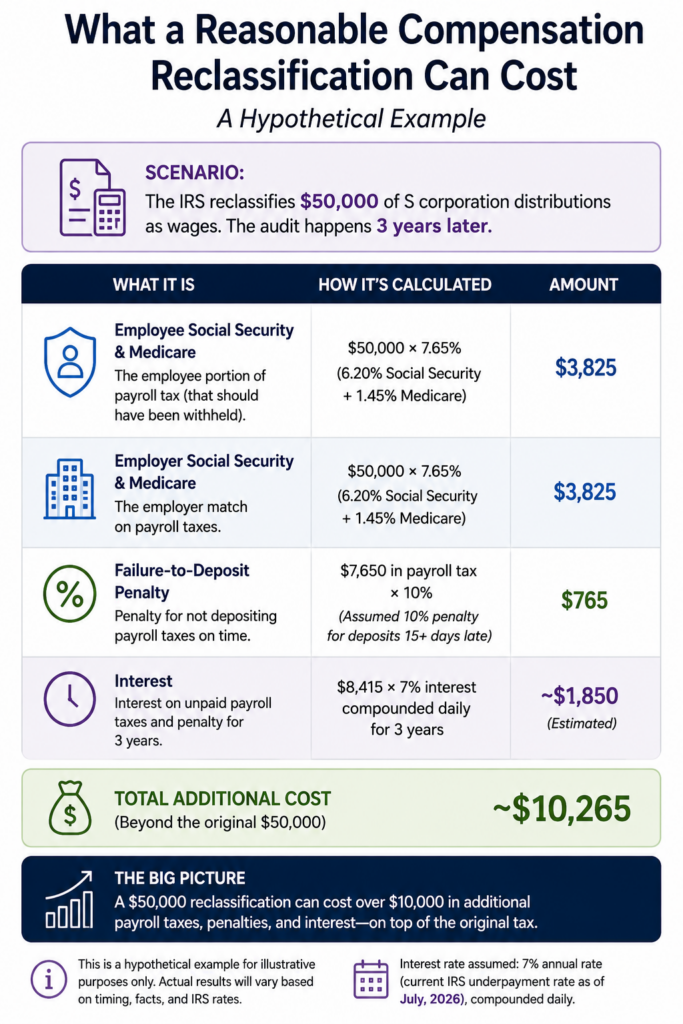
If the IRS determines your salary was unreasonably low, it may reclassify distributions as wages and assess:
- Additional payroll taxes
- Penalties
- Interest
The worst part is that IRS examinations often occur several years after the tax return was filed. By then, penalties and interest may have been accumulating for years without you even realizing it. Below is an example of what a reclassification of $50,000 three years later could cost you.
There Is No Magic Percentage
One of the most common myths is that owners should pay themselves a percentage of business income:
- 40% salary/60% shareholder distributions
- 50% salary/50% shareholder distributions
- 60% salary/40% shareholder distributions
None of these percentages appear in the Internal Revenue Code or IRS guidance linked earlier in this blog post.
A salary should not be determined by a fixed percentage of business income.
Instead, it should reflect the value of the services actually performed.
Two therapy practices with identical profits could have very different reasonable compensation amounts depending on how each owner operates the business.
Factors Unique to Therapy Practices
Reasonable compensation for therapists, psychologists, and psychiatrists often depends on the structure of the practice.
For example:
A solo therapist seeing 30 clients per week may perform nearly every function of the business, including:
- Clinical work
- Scheduling
- Billing
- Marketing
- Administration
- Office cleaning
Another mental health practice owner may employ office staff, billers, associate therapists, and a practice manager while spending most of their time leading the practice, supervising clinicians, and making business decisions.
Even if both practices generate similar profits, the value of the owner’s services may be very different. As a result, their reasonable compensation may also be very different. This is one reason compensation should be revisited as a practice grows. If you are making that transition, our guide to moving from solo to group therapy practice explains how adding clinicians can also affect bookkeeping, payroll, taxes, and practice profitability.
One of the resources I frequently use when evaluating reasonable compensation for therapists is the Bureau of Labor Statistics (BLS) Occupational Employment and Wage Statistics (OEWS). The BLS publishes annual wage data by occupation, state, and metropolitan area, making it an excellent starting point when evaluating reasonable compensation. For example, the 2025 BLS data reports an average annual wage of $76,960 for Marriage and Family Therapists nationwide. From there, I consider additional factors such as geographic location, experience, responsibilities, and the specific role the practice owner performs.
How Do You Support Your Salary If the IRS Asks?
The IRS doesn’t require a formal reasonable compensation study. However, if your salary is ever questioned, it’s helpful to be able to explain how you arrived at it.
Documentation may include:
- Bureau of Labor Statistics (BLS) wage data for psychologists, therapists, counselors, or social workers in your geographic area.
- Current job postings for similar positions with comparable responsibilities and experience.
- A breakdown of your actual duties, including time spent providing patient care versus administrative work, supervision, business management, and marketing.
- A written explanation describing how your education, experience, licenses, certifications, and responsibilities support your salary.
Good documentation demonstrates that your salary was selected using objective information instead of simply trying to reduce payroll taxes. I also recommend reviewing your compensation periodically, especially if your responsibilities or the structure of your practice changes.
If you’re still feeling unsure about the numbers you’re finding, you can sign up for a reasonable compensation study through platforms such as RC Reports or WageProof.
Frequently Asked Questions
Can I pay myself only through shareholder distributions?
No. If you actively work in your S corporation, the IRS generally expects you to receive reasonable compensation through payroll before taking shareholder distributions.
Is there a minimum salary required?
No. The IRS does not publish a minimum salary or required percentage. Compensation depends on the specific facts and circumstances of your business.
Does higher business income automatically mean a higher salary?
Not necessarily. Business profitability is one factor, but the primary consideration is the value of the services you provide to the practice.
Should I use online salary calculators?
Online calculators can provide a starting point, but they typically cannot evaluate the unique facts of your practice, responsibilities, geographic market, or business structure.
How often should I review my reasonable compensation?
The IRS does not require you to recalculate your salary every year. However, it is a good idea to review your compensation periodically, particularly if your clinical workload, staffing, responsibilities, or practice structure has changed significantly.
Need Help Determining a Reasonable Salary?
Determining reasonable compensation is not about choosing the lowest salary possible. It is about choosing a salary that you can confidently support if the IRS ever asks how you arrived at it.
I work with therapists, psychologists, psychiatrists, and group practice owners to evaluate reasonable compensation using IRS guidance, market salary data, and the specific facts of each practice.
If you’re considering an S corporation election or would like a second opinion on your current salary, schedule an Initial Consultation.