

Health Savings Accounts (HSAs) have long been one of the most valuable tax planning tools available to therapists and other self-employed professionals. Recent changes to federal law have made them even more valuable by permanently allowing qualifying High Deductible Health Plans (HDHPs) to cover telehealth services before the deductible without affecting HSA eligibility.
While this change benefits patients, it may also benefit therapy practices. By removing a financial barrier to virtual care for some HSA-eligible patients, therapists who offer telehealth may have an opportunity to attract new patients while continuing to take advantage of one of the tax code’s most valuable deductions.
What Changed?
Before this law, qualifying HDHPs generally could not cover telehealth services before the deductible without affecting a patient’s ability to contribute to an HSA. Congress temporarily suspended that restriction during the COVID-19 pandemic, but the relief was scheduled to expire.
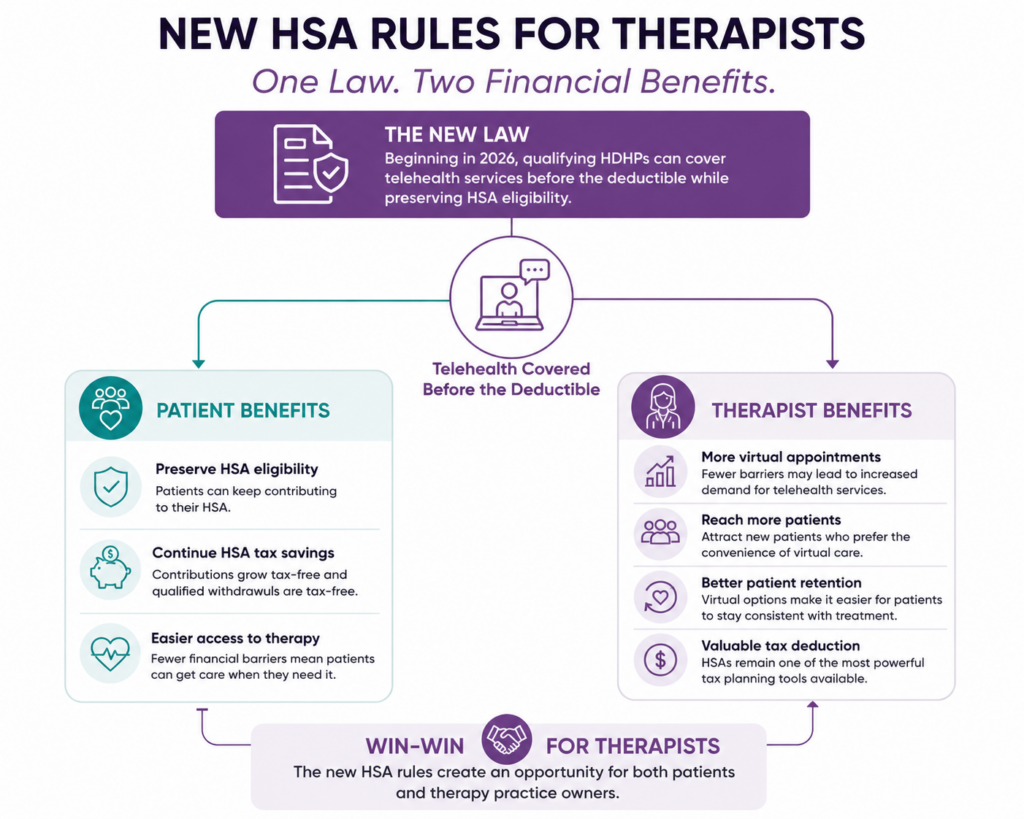
Beginning in 2026, the new law permanently restores that flexibility, allowing qualifying HDHPs to cover telehealth services before the deductible while preserving HSA eligibility.
How This Could Increase Revenue
Many individuals enrolled in High Deductible Health Plans appreciate the convenience of virtual appointments but were previously uncertain how telehealth benefits affected their HSA eligibility. By permanently allowing qualifying plans to cover telehealth before the deductible, Congress has removed much of that uncertainty.
As a result, therapists, psychiatrists, psychologists, counselors and other mental health providers may benefit from:
- Increased demand for virtual appointments.
- Improved patient retention.
- Greater flexibility for patients balancing work, childcare, or transportation challenges.
- A larger pool of prospective patients who value telehealth convenience.
Practices that already offer virtual therapy may be well positioned to benefit. If your practice offers telehealth services, consider adding a brief statement to your website reminding prospective patients to review their health plan benefits and HSA eligibility with their insurance provider.
Keyword search from Ahrefs shows that “online therapy” is searched more than 100,000 times per month in the United States. Highlighting your virtual services may help differentiate your practice while making it easier for prospective patients to schedule an appointment.

If your practice doesn’t currently offer virtual appointments, this may be a good time to reconsider. The American Psychiatric Association recognizes telepsychiatry as a legitimate component of mental health care, and patient demand for virtual services continues to grow. Telehealth is a growing trend that has now unlocked access to HSA funds – currently worth over $85 Billion.
Tax Benefits for Therapists
If you own your own practice and participate in a qualifying High Deductible Health Plan, an HSA remains one of the few accounts that offers three separate tax advantages.
- Contributions are generally tax deductible.
- Investment earnings grow tax-free.
- Qualified medical withdrawals are tax-free.
Few tax strategies offer all three benefits simultaneously.
Unlike Flexible Spending Accounts (FSAs), unused HSA funds remain yours indefinitely. Many therapists intentionally allow their HSA balances to accumulate over time, using the account as an additional retirement planning tool while paying current medical expenses out of pocket whenever practical.
For practice owners looking to reduce taxable income, maximizing HSA contributions should be part of the annual tax planning conversation.
For example:
- Keeping accurate bookkeeping records throughout the year also makes it easier to coordinate HSA contributions, retirement contributions, retirement planning, payroll, and year-end tax preparation.
- Choosing the correct entity structure.
- Coordinating HSA contributions with retirement plan contributions.
- Determining whether an S corporation still makes sense for your practice.
- Ensuring payroll is handled correctly if your business is taxed as an S corporation.
- Planning estimated tax payments throughout the year.
A proactive tax strategy often saves significantly more than simply claiming deductions at tax time.
Final Thoughts
The new HSA rules represent more than just another tax law update.
For therapists, they create a rare opportunity where one legislative change may benefit both sides of your financial picture. Patients enrolled in qualifying High Deductible Health Plans gain additional flexibility to access telehealth services, while practice owners may see increased demand for virtual appointments and continue taking advantage of one of the most valuable tax deductions available.
If you’re a therapist with questions about HSAs, S corporations, bookkeeping, or proactive tax planning, working with a CPA who understands private practice can help you make the most of these opportunities before tax season arrives.